

Henry Coleman Baskerville (Henry Coleman Baskerville)
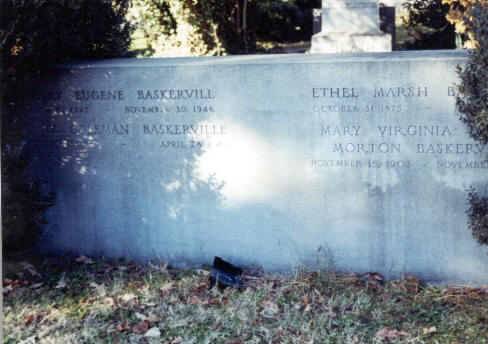
Baskervill and Son has maintained a consistent history as one of the most successful Richmond, Va., architectural firms since its establishment in 1897. The firm, then called Noland and Baskervill, was the partnership of architect William Churchill Noland (1865-1951) and electrical engineer Henry Baskervill (1867-1930). The firm began to develop its reputation in the Richmond area by taking on several prominent residential projects such as Baskervill’s own residence (1913) in addition to several homes on Monument Avenue. In 1903, even though the firm was not yet six years old, it received the prestigious commission to design an addition for Thomas Jefferson’s Virginia State Capitol Building. As this project implies, even as a young firm, Noland and Baskervill had developed a substantial reputation among Richmond’s elite.
The Noland and Baskervill partnership dissolved in 1918 with Noland’s retirement; Henry Baskervill quickly joined with Alfred G. Lambert to form a new partnership, Baskervill & Lambert. In 1932, Henry Baskervill’s son H. Coleman Baskerville (1905-1969) joined the firm, and the name changed again, to Baskervill & Son. When he succeeded to the directorship of the company, H. Coleman Baskerville changed the spelling of his surname, and that of his company, to “Baskerville.” With H. Coleman Baskerville’s death, the “e” was dropped and the original spelling retained.
In the early years of the firm, commissions trickled in. Between 1894 and 1900 there are only 14 projects. These included three churches, four commercial buildings, two hospitals and two residences. However, in the first decade of the Twentieth century, the firm undertook at least 80 projects, and with the exception of the years during World War I and World War II, this rate increased exponentially.
Early on, the firm began working with the Medical College of Virginia Hospital and St. Luke’s Hospital in Richmond, Va., and later with both Central and Eastern State psychiatric hospitals, in Petersburg and Williamsburg, respectively. Eventually, the Blue Ridge Sanatorium (Charlottesville), Crippled Childrens Hospital (Richmond), Danville (Va.) Memorial Hospital, Grace Hospital (Richmond), Louise Obici Memorial Hospital (Suffolk), Petersburg (Va.) General Hospital, Retreat Hospital (Richmond), Richmond Memorial Hospital, Sheltering Arms Hospital (Richmond), Southside Community Hospital (Farmville), University of Virginia Hospital (Charlottesville), and the Virginia Home for Incurables (Richmond) appeared on the firm’s client list.
A number of well-known educational institutions turned to Baskervill & Son for assistance in upgrading existing buildings or designing new ones. In addition to the Medical College of Virginia, mentioned above, the firm worked with Episcopal High School (Alexandria), the Foxcroft School (Middleburg), Mary Baldwin College (Staunton), St. Christopher’s School (Richmond), Union Theological Seminary (Richmond), and the University of Virginia in Charlottesville, designing everything from steam tunnels to dormitories and classroom buildings.
The firm designed a wide range of commercial facilities, from small family-run stores (such as the Andrew J. Briggs residence and drugstore on Grove Avenue, Richmond) to office buildings, factories and warehouses for the likes of Philip Morris, Inc., and the Richmond News Leader Co., as well as a number of local and national banks.
Also prominently represented are a large number of Richmond churches, including Grace and Holy Trinity, St. Andrew’s Episcopal, St. James Episcopal, St. John’s Methodist, St. Paul’s Episcopal, and Second Baptist.
There are a relatively small number of “cultural” projects, primarily libraries, including the State Library and Archives on Capitol Square; several social clubs, including the Commonwealth Club, Westmoreland Club, and Country Club of Virginia; and a few museums, such as the Confederate Memorial Institute, the Edgar Allen Poe Museum, and the Virginia Museum of Fine Arts.
While the firm did a substantial amount of work for commercial, cultural, educational, medical and religious organizations and institutions, the bulk of its projects during the period covered by these records were residential. Major private residences which the firm either designed or added-to included “Maymont,” in Richmond, Va., and “Swannanoa,”on Afton Mountain, Va., both commissioned by Maj. James H. Dooley. The firm also designed homes for Mrs. John Stewart Bryan (“Montebello”), Joseph Bryan (“Eagle Point”), E. M. Crutchfield (“Reveille”), Granville Gray (“Rothesay”), Lewis G. Larus (“Stony Point”), Legh R. Page (“Pagebrook”), Malvern C. Patterson (“Hillcrest”), Virgil P. Randolph (“Estouteville”), William T. Reed, Jr. (“Sabot Hill”), Frederic W. Scott (“Royal Orchard”), George Cole Scott (“Ballyshannon”), Elijah B. White (“Selma”), and Edward J. Willis (“Pembroke”), as well as a number of other prominent Richmonders, and created model homes for Windsor Farms, Inc., and Hillcrest, Inc., two Richmond realty corporations. Many of these homes were located in the Fan, Ginter Park, West End, Westhampton, and Windsor Farms neighborhoods of Richmond.
This collection is made up of two series. Series One contains architectural plans for projects dating from 1894-1950. These range from one to many sheets, and typically include elevations and floor plans, but sometimes also extend to structural plans, interior details for cornices and staircases, and occasionally even garden plans. Series Two contains specifications, contracts and scattered photographs relating to these projects, plus correspondence and other materials on two design competitions in which Baskervill participated, including the Jefferson Davis monument (Proj. 1907-25) on Monument Avenue, Richmond, and the Federal Reserve Bank Building (Proj. 1917-12), East Byrd Street, Richmond.
This guide includes a list of projects by number and includes as much information as is currently known about the client, type of project, and location. Since the project number is based on the year undertaken and the project’s order within that year, this list serves as a chronological record of Baskervill & Son’s work. The appendices include a list of projects arranged alphabetically by client as well as a list of projects with Richmond addresses (when known).
The collection is not a comprehensive guide to the Baskervill firm’s work, as not all of the firm’s commissions for the time period are included.
Born
- August, 10, 1905
- Richmond, Virginia
Died
- April, 28, 1969
- Richmond, Virginia
Cemetery
- Hollywood Cemetery
- Richmond, Virginia